
Fed Rate Hike: Three Investment Strategies for Market Changes
- Authors

- Name
- MarketVibe Team
- @1marketvibe
Fed Rate Hike: Three Investment Strategies for Market Changes
The Federal Reserve's recent decision to hike interest rates has sent ripples across the financial markets, prompting investors to reassess their strategies. Understanding the implications of this move is crucial for navigating the evolving landscape. MarketVibe's proprietary Enhanced CW Index, a 0-10 scale that provides 4-6 week early warning of market corrections by tracking institutional gold flows and market breadth, is currently at 5.7. This level is below the 7.0 warning threshold, indicating a moderate risk environment.
Learn more about how CW Index works at 1marketvibe.com.
Impact on Investment Strategies
Interest rate hikes typically influence asset allocation and risk tolerance among investors. As borrowing costs rise, sectors sensitive to interest rates, such as real estate and utilities, may face pressure. Conversely, financial stocks often benefit from higher rates due to improved net interest margins. MarketVibe's CW Index suggests that while the current reading indicates moderate risk, investors should remain vigilant as the index provides an early warning of potential market corrections.
Market Reactions
The immediate market response to the rate hike has been mixed. Historically, when the CW Index hit 7.1 in March 2023, markets fell 8.3% over the following month. This underscores the importance of monitoring the CW Index for shifts that could signal increased volatility. The gold component of the CW Index offers a unique advantage, providing a 4-6 week advance notice of potential market downturns.
Sector-Specific Implications
Higher interest rates can have varied effects across different sectors:
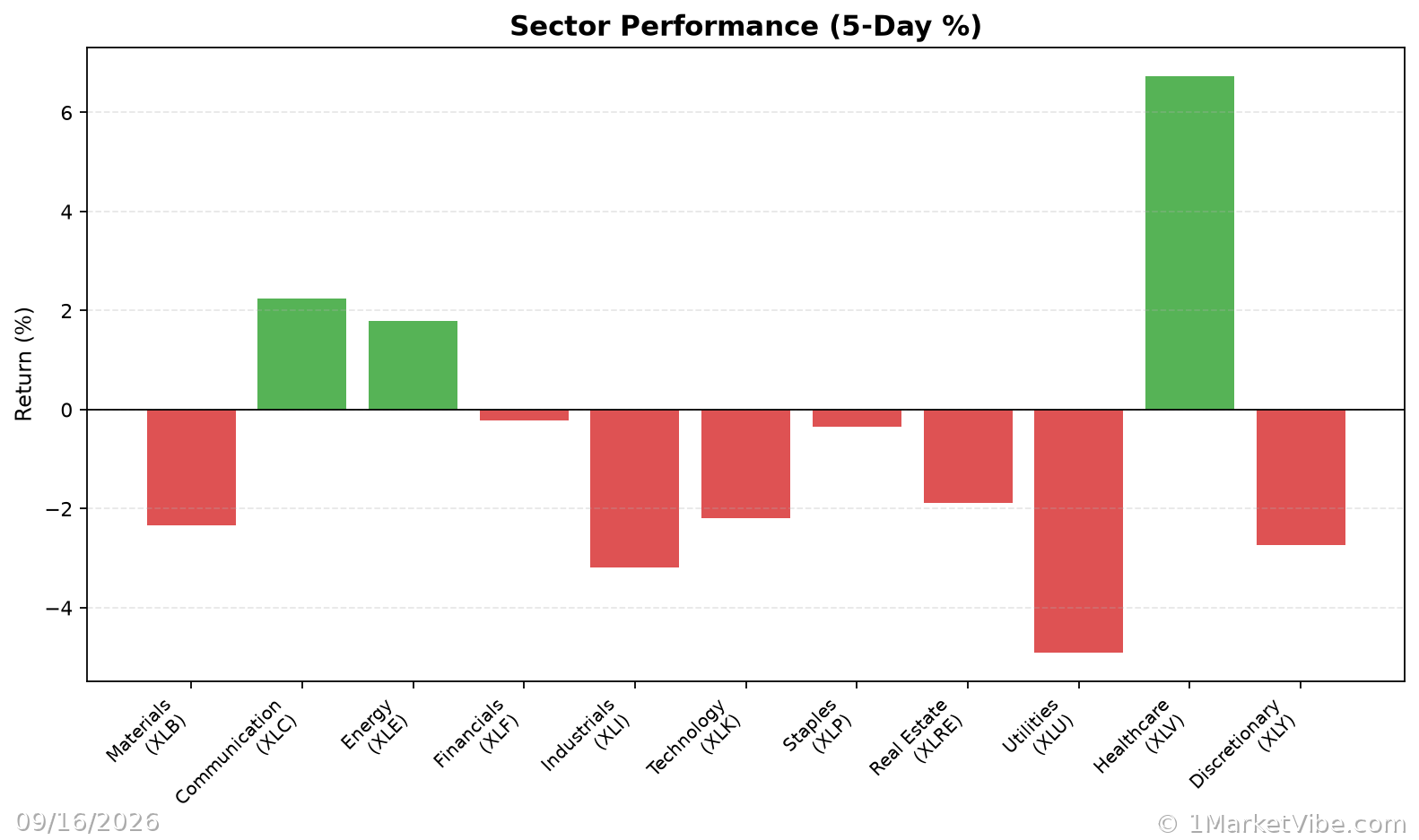
- Real Estate: Increased borrowing costs may dampen demand for new properties, impacting real estate investment trusts (REITs).
- Utilities: These typically high-dividend sectors may become less attractive as bond yields rise.
- Financials: Banks and financial institutions could see improved profitability due to higher interest income.
MarketVibe's CW Index at 5.7 suggests a cautious approach, particularly in interest-sensitive sectors.
Bond Market Dynamics
Rising interest rates generally lead to higher bond yields and lower bond prices. For bond investors, this environment necessitates strategic adjustments:
- Consider shorter-duration bonds to mitigate interest rate risk.
- Explore inflation-protected securities, which may offer better returns in a rising rate environment.
MarketVibe tracks these dynamics, providing insights into how bond markets might react as the CW Index evolves.
Equity Market Considerations
Equity valuations can be sensitive to interest rate changes. Higher rates may lead to a revaluation of growth stocks, which are often more sensitive to changes in discount rates. Investors should focus on:
- Resilient Stocks: Companies with strong balance sheets and pricing power may better withstand rate hikes.
- Dividend Stocks: These can offer stable income, although their appeal might diminish compared to rising bond yields.
According to MarketVibe data, monitoring the CW Index for any upward movement towards the 6.5 level could indicate increased market pressure.
Alternative Investments
In a high-rate environment, alternative investments can provide diversification and potential hedges against volatility:
- Commodities: Gold and other commodities may serve as effective hedges, especially given the CW Index's gold flow component.
- Real Assets: Investments in infrastructure and real estate can offer inflation protection and income.
MarketVibe's proprietary system highlights the importance of considering these alternatives as part of a balanced investment strategy.
MarketVibe Decision Edge™: Your Action Plan
MarketVibe's Decision Edge™ Method simplifies complex market signals into three clear steps: Glance → Learn → Act. This proprietary framework turns market intelligence into actionable decisions.
🔍 Glance (10-Second Takeaway)
- Current CW Index Reading: 5.7, indicating moderate risk.
- Overall Market Status: Yellow flag.
- Key Metric to Watch: CW Index movement towards 6.5.
📚 Learn (2-Minute Deep Dive)
The Fed's rate hike reflects ongoing efforts to manage inflation, which has implications for various asset classes. Historically, similar rate hikes have led to market volatility, as seen when the CW Index reached 7.1 in March 2023, resulting in an 8.3% market decline. Investors should monitor the CW Index closely, as its gold component provides a 4-6 week early warning of potential corrections. Understanding these dynamics is crucial for making informed investment decisions.
⚡ Act (Specific Steps)
For Conservative Investors:
- Increase allocation to short-duration bonds.
- Consider inflation-protected securities.
For Growth-Oriented Investors:
- Focus on resilient stocks with strong fundamentals.
- Monitor the CW Index for signs of increased risk.
For Diversified Portfolios:
- Incorporate commodities and real assets as hedges.
- Adjust sector exposure based on interest rate sensitivity.
Access MarketVibe's full Decision Edge framework at 1marketvibe.com →
Conclusion
The Fed's rate hike presents both challenges and opportunities for investors. By leveraging MarketVibe's Enhanced CW Index and Decision Edge™ Method, investors can gain early warnings and actionable insights to navigate these changes effectively. As always, reassessing portfolios in light of new market conditions is essential for maintaining a balanced investment strategy.
Disclaimer: This article is for informational purposes only and does not constitute financial advice. Always consult with a financial advisor before making investment decisions.